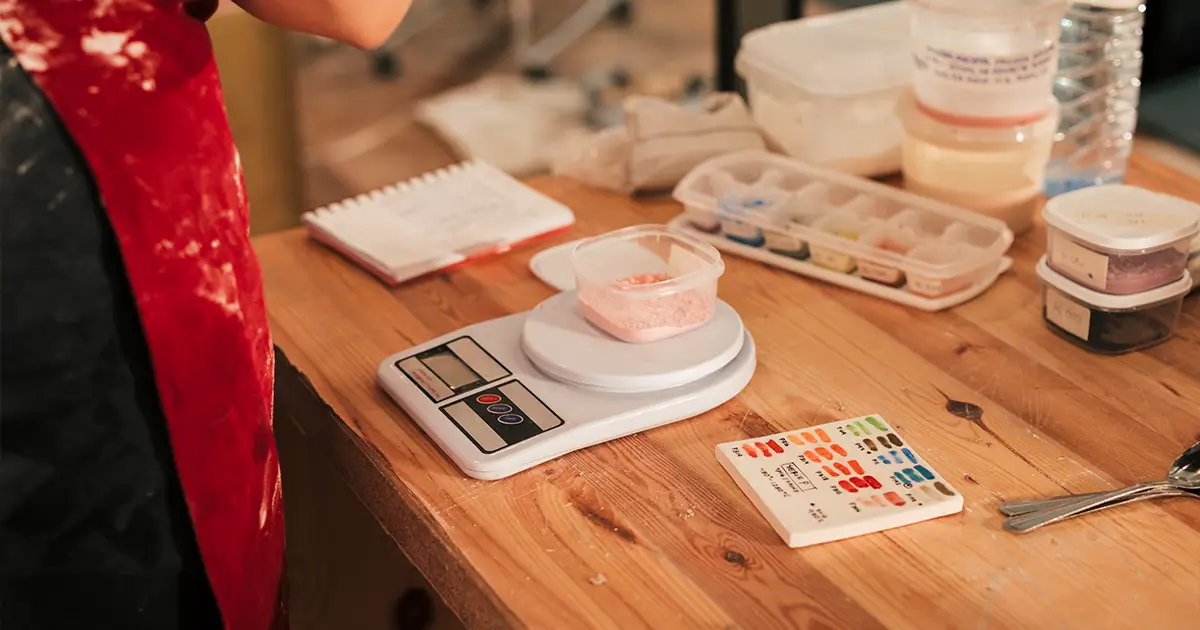
Pricing handmade products can be surprisingly difficult.
You know what you paid for the materials. You probably know roughly how long the product takes to make. But turning those numbers into a selling price that customers will accept and that still leaves you with worthwhile profit is another problem.
One common mistake is using a shortcut such as:
Materials × 2 = Selling Price
Another is looking at similar products online and simply choosing a comparable price.
Neither approach tells you whether that price actually works for your business.
A more useful approach is to calculate what it really costs to produce and sell the item, then build profit into the price.
This guide shows you how to do that step by step.
Why Handmade Products Are Easy to Underprice
Handmade businesses have costs that are easy to overlook.
Suppose you use $8 of materials to make a product and sell it for $25.
You might initially calculate:
$25 – $8 = $17 profit
But the $8 only represents your materials.
You may also have paid for:
- Packaging
- Your production time
- Selling fees
- Payment processing
- Shipping
- Equipment
- Tools
- Advertising
- Workspace expenses
- Software
- Damaged or wasted materials
Once those costs are considered, the $17 can shrink quickly.
That is why the first step in pricing a handmade product is understanding its true cost.

A Simple Handmade Product Pricing Formula
A practical starting framework is:
Materials + Labor + Packaging + Overhead + Selling Costs + Desired Profit = Target Selling Price
The exact calculation can become more complicated when some selling costs are percentage-based, but this framework helps make sure the major components are not forgotten.
Let’s calculate each one.
Step 1: Calculate Your Material Cost
Start with every material that goes directly into one finished product.
For example, if you make handmade candles, your materials could include:
- Wax
- Fragrance oil
- Wick
- Container
- Dye
- Lid
- Product label
The important part is calculating the amount actually used per product.
Suppose you buy 10 pounds of material for $50.
Cost per pound:
$50 ÷ 10 = $5
If one product uses 0.4 pounds:
$5 × 0.4 = $2
That product uses $2 worth of that particular material.
Repeat the calculation for each component.
For example:
| Material | Cost Per Product |
|---|---|
| Main material | $5.00 |
| Components | $2.00 |
| Label | $0.50 |
| Decorative material | $0.50 |
| Total materials | $8.00 |
Your material cost is therefore:
$8.00 per product
Step 2: Include Packaging
Packaging is often treated as an afterthought.
But if every order requires packaging, it is part of the cost of selling the product.
Examples include:
- Shipping boxes
- Mailers
- Tissue paper
- Bubble wrap
- Tape
- Stickers
- Thank-you cards
- Product boxes
- Protective inserts
Suppose the packaging for one order costs:
$1.50
Your running cost is now:
Materials: $8.00
Packaging: $1.50
Total so far: $9.50
A few cents or dollars may not seem important on one order, but repeated across hundreds of sales they can materially affect profitability.
Step 3: Calculate Your Labor Cost
This is where many handmade sellers underprice their work.
Your time has value.
A simple formula is:
Hourly Labor Rate × Hours Required = Labor Cost
Suppose you decide your labor should be valued at $20 per hour.
One product takes 30 minutes to make.
Thirty minutes equals 0.5 hours.
Therefore:
$20 × 0.5 = $10
Your labor cost per product is:
$10
Now your running cost becomes:
Materials: $8.00
Packaging: $1.50
Labor: $10.00
Total so far: $19.50
This calculation is particularly important for handmade products because two products with similar material costs can require very different amounts of work.
Don’t Forget Time Outside Production
Production time isn’t always the only labor involved.
Depending on your business, you may also spend time:
- Preparing orders
- Packaging products
- Printing labels
- Communicating with customers
- Buying supplies
- Photographing products
- Updating listings
- Managing inventory
- Handling returns or replacements
You don’t necessarily need to assign every administrative minute directly to one product.
But those hours still exist and should be reflected somewhere in the economics of your business.
Step 4: Allocate Business Overhead
Some expenses support the entire business rather than one individual product.
These are often treated as overhead.
Examples can include:
- Equipment
- Tools
- Workspace
- Utilities
- Website expenses
- Software subscriptions
- Photography equipment
- Business insurance
- Marketing tools
- Office supplies
A simple way to estimate overhead per product is:
Monthly Overhead ÷ Expected Monthly Units Sold = Estimated Overhead Per Unit
Suppose your monthly overhead is $400.
You expect to sell 100 products.
Your estimated overhead allocation is:
$400 ÷ 100 = $4 per product
Add that to our example:
Materials: $8.00
Packaging: $1.50
Labor: $10.00
Overhead: $4.00
Cost before selling-related expenses: $23.50

This doesn’t need to be a perfect accounting allocation to be useful for internal pricing analysis.
The objective is to avoid pretending indirect business expenses do not exist.
Step 5: Account for Selling Costs
The cost of selling depends on where and how you sell.
You might sell through:
- Etsy
- Your own website
- An online marketplace
- Craft fairs
- Wholesale
- Social media
- A physical store
Different channels can create different costs.
Depending on the channel, selling expenses may include:
- Listing fees
- Transaction fees
- Payment processing
- Marketplace commissions
- Advertising
- Point-of-sale fees
- Website payment fees
Some of these costs are fixed.
Others are percentages of the transaction.
That distinction matters because percentage-based costs increase as the selling price increases.
For Etsy sellers specifically, our guide How Much Does Etsy Take From Each Sale? Etsy Fees Explained breaks down the main fee categories you may need to consider.
Step 6: Consider Shipping Costs
If the buyer pays shipping separately, you still need to understand the actual cost of fulfillment.
If you advertise “free shipping,” the shipping is not actually free.
Your business is paying for it.
Suppose shipping costs you $6 per order and you absorb the full amount.
That $6 needs to be supported by the economics of the sale.
If your product price doesn’t account for it, your profit will be lower than expected.
Also consider costs associated with shipping, such as:
- Boxes or mailers
- Protective materials
- Labels
- Carrier charges
- Shipping insurance where applicable
The customer’s shipping charge and your actual fulfillment cost are not necessarily the same number.
Step 7: Add the Profit You Want
Once you understand your costs, decide what return you want the product to generate.
This is different from simply adding an arbitrary markup.
Suppose your relevant product costs total $23.50 before percentage-based selling fees and shipping.
If you want the product to contribute $10 in profit, your eventual selling price needs to support:
$23.50 of costs + selling expenses + shipping you absorb + $10 desired profit
This is why starting with the desired selling price and hoping enough profit remains can be risky.
Start with the economics first.
Then test whether the resulting price makes sense in the market.
A Handmade Pricing Example
Let’s put everything together.
Suppose you sell a handmade item with the following costs:
| Cost | Amount |
|---|---|
| Materials | $8.00 |
| Packaging | $1.50 |
| Labor | $10.00 |
| Allocated overhead | $4.00 |
| Subtotal | $23.50 |

Now imagine you consider selling the product for $40.
Before selling fees and any shipping you absorb:
$40 – $23.50 = $16.50
It may initially appear that you have $16.50 of profit.
But if the transaction also generates marketplace/payment fees or you absorb shipping, those costs still need to come out of that amount.
For example, if other relevant selling and fulfillment expenses totaled $7:
$40 – $23.50 – $7 = $9.50
Your resulting profit under this simplified example would be:
$9.50
And the corresponding margin would be:
$9.50 ÷ $40 × 100 = 23.75%
The example demonstrates why the selling price alone tells you very little about profitability.
Markup vs Profit Margin
Another common pricing mistake is confusing markup with margin.
Suppose your cost is $20 and your selling price is $30.
Profit:
$30 – $20 = $10
Markup:
$10 ÷ $20 × 100 = 50%
Profit margin:
$10 ÷ $30 × 100 = 33.3%
A 50% markup therefore does not produce a 50% margin.
If you want to understand this in more detail, see our guide on what makes a good profit margin on Etsy.
Even if you don’t sell exclusively on Etsy, the underlying difference between markup and margin remains useful when pricing handmade products.
Should You Use Materials × 2 or Materials × 3?
You’ll sometimes see handmade pricing formulas such as:
Materials × 2
or:
Materials × 3
These shortcuts are easy to calculate.
The problem is that they assume material cost has a reliable relationship with every other cost.
It often doesn’t.
Consider two products that each use $10 of materials.
Product A takes 15 minutes to make.
Product B takes two hours to make.
Using:
Materials × 3 = $30
would produce the same selling price for both.
But their labor economics are completely different.
A formula that ignores time, overhead, selling expenses, and other costs can therefore create misleading prices.
Should You Copy Competitors’ Prices?
Competitor research is important, but it should be used as a reality check rather than your entire pricing method.
Suppose competitors sell similar products for $30.
Your calculation says you need $42.
You now have useful information.
You can investigate:
- Are your material costs too high?
- Is your production process inefficient?
- Are the competitor products actually comparable?
- Are competitors operating at greater scale?
- Is your product positioned as more premium?
- Can the product be redesigned?
- Can you reduce unnecessary costs?
- Is the market willing to pay for your differentiation?
Simply changing your price to $30 does not make your costs disappear.
Wholesale Pricing Changes the Equation
If you plan to sell handmade products wholesale, you need additional room in your pricing structure.
A retailer purchasing your product generally needs an opportunity to resell it profitably.
If your direct-to-customer retail price barely covers your own costs, offering a substantial wholesale discount can quickly make the product unsustainable.
This is another reason to build pricing from actual costs rather than selecting an attractive retail price first.
Before offering wholesale pricing, calculate what remains for your business at the wholesale price.
Discounts Can Quietly Destroy Your Margin
Suppose a product normally sells for $40.
You run a 20% discount.
The new price is:
$40 × 0.80 = $32
That’s an $8 reduction in revenue.
If your original profit was only $10 per product, an $8 discount does not reduce your profit by 20%.
It can reduce it dramatically.
This is why discounts should be tested against profit, not just revenue.
Before running a promotion, calculate:
Discounted Selling Price – Total Relevant Costs = Expected Profit
If the result isn’t worthwhile, reconsider the discount.
Your Price Should Not Stay Fixed Forever
Material costs change.
Shipping rates change.
Packaging costs change.
Marketplace fees can change.
Your production process can change.
Customer demand can change.
A price that worked when you launched the product may no longer make sense a year later.
Review prices whenever there is a significant change in your cost structure.
A periodic pricing review can also catch gradual cost increases before they consume too much of your margin.
Calculate Profit Product by Product
If you sell ten different handmade products, don’t assume they all perform similarly.
One product may:
- Sell frequently but have a low margin
- Have expensive materials
- Require too much labor
- Cost more to ship
- Generate more advertising expense
Another may sell less frequently but produce substantially more profit per order.
Track each product separately whenever practical.
Revenue tells you what customers paid.
It does not tell you what you kept.
Turn Your Costs Into a Repeatable Pricing System
Once you have several products, repeatedly calculating materials, labor, packaging, selling fees, profit, and margin by hand becomes inefficient.
A structured spreadsheet can make the process easier to repeat and update when your numbers change.
The True Cost & Profit Calculator — Etsy Edition is designed to help sellers bring product costs, fees, selling price, profit, and margin into one place.
Although it is designed around Etsy selling economics, the core idea is simple: know the costs behind the product before deciding whether its price is working.
View the True Cost & Profit Calculator — Etsy Edition
Handmade Product Pricing Checklist
Before finalizing a product price, ask:
- Have I calculated the actual materials used?
- Have I included packaging?
- Have I valued my production time?
- Have I considered other labor?
- Have I allocated relevant overhead?
- Have I accounted for selling fees?
- Have I considered payment processing?
- Have I included shipping that I absorb?
- Do I know my desired profit?
- Do I understand the resulting margin?
- Have I checked comparable products?
- Can the business sustain this price if costs increase?
- What happens to profit when I offer a discount?
If you cannot answer several of these questions, your selling price may be based on incomplete information.
Frequently Asked Questions
What is a simple formula for pricing handmade products?
A useful starting framework is:
Materials + Labor + Packaging + Overhead + Selling Costs + Desired Profit = Target Selling Price
Some selling costs may be percentage-based, so the exact calculation can require additional adjustments.
Should labor be included in handmade product pricing?
Yes, if you want your pricing analysis to reflect the economic cost of producing the item.
Ignoring your own time can make a labor-intensive product appear much more profitable than it actually is.
How do I calculate labor cost for a handmade product?
Use:
Hourly Rate × Time Required = Labor Cost
If your labor rate is $20 per hour and a product takes 45 minutes, convert 45 minutes to 0.75 hours:
$20 × 0.75 = $15 labor cost
Should packaging be included in product cost?
If packaging is required to prepare or deliver the product, it should be considered when evaluating what the sale costs your business.
How often should I change my handmade product prices?
There is no universal schedule. Review your prices when important costs change and periodically check whether existing prices still produce acceptable profit.
Final Takeaway
The best handmade pricing formula is not necessarily the shortest one.
A formula such as materials × 2 may be convenient, but convenience doesn’t make it accurate for every product.
A more useful pricing process starts by understanding:
Materials + Labor + Packaging + Overhead + Selling Costs + Desired Profit
Then compare the resulting price with customer expectations and the market.
If the market won’t support the price you need, don’t automatically cut the price.
Investigate the underlying costs, production process, positioning, and value of the product.
The objective is not simply to make sales.
It is to make sales at prices that allow the business behind those products to remain financially sustainable.